
A good response time for enquiries is within one hour during working hours, and within five to fifteen minutes for new website enquiries and sales leads. Email can wait up to the same working day at the latest. These are recommended targets, not universal standards, and faster is almost always better.
At a glance
- Within one business hour is a strong first human reply target for a UK SME, and within one business day is the minimum most customers accept.
- Live chat replies are expected in seconds, many customer emails within an hour or less, and social media within up to a day, according to TextExpander’s response time benchmarks.
- A 2011 Harvard Business Review study of 2,241 firms found only 37% replied to web leads within an hour and 23% never replied, as reported by Formcrier.
- Recommended short answer: reply to a website enquiry within an hour, and the same working day at the latest.
- The clock should start when the enquiry arrives, and an automatic message should not count as a real response, as Onpipeline explains.
What is a good response time for enquiries?
Aim to reply within an hour during working hours, within minutes for new website enquiries and leads, and by the end of the same working day at the very latest. Treat this as a recommended target for a UK small business, not a rule.
No official body sets a standard response time for UK businesses. What you read online is guidance, drawn from surveys and sales studies, and the numbers vary from one source to the next. That is why we suggest picking a target you can actually keep, writing it down and sticking to it.
The reply that counts is the first human one. A customer who has sent a question wants to know that a real person has seen it and is dealing with it. An automatic “thanks for your message” is polite, but it does not answer anything. We cover that point in more detail further down.
The table in the next section gives a target for each type of enquiry, so you can copy it straight into your own policy.
What response time should you aim for by enquiry type?
Different channels carry different expectations. The table below sets out an ideal time and a latest acceptable time for each. These are recommended targets, and you should adjust them to suit your team and your trade.
| Enquiry type | Ideal first reply | Latest acceptable |
|---|---|---|
| Website forms | 5 to 15 minutes | 1 hour |
| New sales leads | Within 5 minutes | 1 hour |
| Within 1 hour | Same working day | |
| Phone | Answer at once | Call back within 15 minutes if missed |
| Social media messages | 1 hour | 3 hours |
| Existing customers | 1 hour | 4 working hours |
| Urgent issues and complaints | As soon as possible, ideally within 15 minutes | 1 hour to acknowledge, with a named person on it |
Which channels suit a faster standard?
Live chat and the phone sit at the quick end. People using them expect an answer in seconds or while they are still on the line. Website forms and new leads come next, because the person has just shown interest and may be asking your competitors too. Email is the most forgiving of the common channels, though an hour is still a strong target.
On the phone, keep hold times short and call back fast if you miss a call. A missed call with no follow-up is, in effect, an unanswered enquiry.
What does this look like in practice?
- Dental practices: a new patient asking about an appointment is a hot lead, so aim for minutes. A question from an existing patient about aftercare sits in the one-hour band.
- Solicitors: a new instruction enquiry deserves a quick human reply, even if the full answer takes longer. Acknowledge, then set a time for the detail.
- Trades: someone asking for a quote is likely calling several firms. A burst pipe or no heating call is urgent and belongs in the top row.
- Letting agents: a viewing request on a new listing goes stale fast, so treat it like a sales lead.
What is a good response time for emails?
Within an hour is a strong target for a customer email, and the same working day is the usual limit. Beyond that, the customer starts to wonder whether anyone is there.
It helps to separate two things. Internal email etiquette, such as replying to a colleague within a day or two, is a different matter from a customer enquiry. A customer who is deciding whether to buy from you is not as patient as a colleague.
What if a full answer needs time?
Send a short, human reply first. Say you have the message, say what you are checking and give a date when they will hear back. Then keep to that date. A clear promise you keep is far better than a vague one you miss.
Who owns the inbox?
Shared inboxes such as info@ or hello@ are where enquiries most often go missing, because everyone assumes someone else has dealt with it. Give each message an owner, even if it is only a name against the email or a simple flag. If nobody owns it, nobody replies.
What does the research say about reply speed?
The research points one way: faster replies tend to win more business. But much of it is American and dated, and UK evidence is thinner, so treat the figures as direction, not proof.
The best known is a 2011 Harvard Business Review study of 2,241 firms. It found that only 37% replied to web leads within an hour, and 23% never replied at all, as Formcrier summarises it. That was over a decade ago and in the US, so the exact figures may not match UK firms today. The wider point, that many businesses are slow or silent, is still a useful warning.
Shopify UK’s guide to first response time also cites PwC figures on customers abandoning a business after poor service. We would read those as a sign of what is at stake rather than a precise forecast for your own firm.
How far do these findings apply to you?
Quite far on the principle, less so on the numbers. A UK dental practice or letting agent will not see the same percentages as a US software firm. What carries over is simple: a quick, useful reply makes you look reliable, and silence costs you enquiries. Use the research to justify a target, then measure your own results.
When does the response clock start and what counts as a reply?
The clock starts when the enquiry arrives, and an auto-reply is an acknowledgement, not a response. A real response is the first human reply that moves things forward.
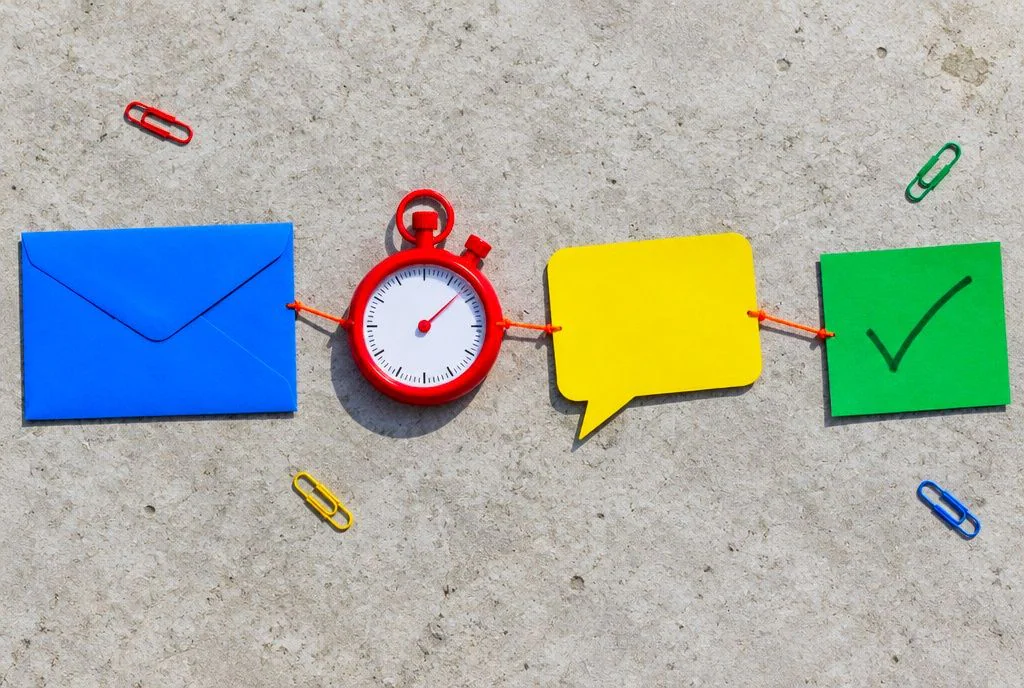
That means a message that says “we have received your enquiry” does not stop the clock. A message that answers the question, offers a booking slot or asks a useful follow-up does. This follows the approach set out by Onpipeline.
Business hours or calendar hours?
Decide which you are measuring and say so. Calendar hours count every hour, including nights. Business hours count only the time you are open. Most small businesses promise in business hours, so an enquiry at 6pm on Friday gets a reply by mid-morning Monday, say, and the customer is told that straight away.
Three terms worth knowing
- First response time: how long from the enquiry arriving to the first human reply.
- Average response time: the typical gap across all replies in a conversation, not only the first.
- Resolution time: how long until the matter is fully sorted.
For most small firms, first response time is the one to watch, because it shapes the customer’s first impression.
How should you handle enquiries outside working hours?
Set an expectation straight away, then reply first thing the next working morning. People forgive a wait when they know how long it will be.

Use a clear out-of-hours message
An automatic message should say when you are open and when they will hear from you. “We will reply by 10am on Monday” is much better than “we will be in touch soon”. It’s only an acknowledgement. Make sure a person does follow up.
Options for evenings and weekends
- Check enquiries once at a set time, such as 8am or 6pm, rather than living in the inbox.
- Share the duty between two people on a simple rota.
- Route phone calls to an answering service or voicemail with a promised call back time.
- Use a chatbot to answer common questions at any hour.
Keep an escalation route for urgent issues
Some enquiries cannot wait until Monday: a leak, a locked-out tenant, a pet in distress. Say plainly how to reach someone for an emergency, and make sure that route works.
Where a chatbot fits
A chatbot can answer routine questions from your website straight away, such as opening hours, services or how to book. Chati does this, and hands the chat to your team when it is unsure, so the harder questions reach a person rather than getting a poor guess.
How can a small business reply faster?
Name an owner for each enquiry, use alerts and templates, and automate the routine questions. Most delays come from unclear ownership, not lack of effort.
Give every enquiry an owner and a backup
One person is responsible for each channel at a given time, and someone else covers when they are out. Holidays and sick days are where replies tend to slip.
Get alerts to the right place
Send notifications to phones, and set up shared inbox rules so new enquiries stand out from the rest of the mail. A fast reply is easier when you know a message has arrived.
Write templates for common questions
Draft replies for the questions you hear every week, such as prices, availability and directions. Keep them friendly and edit each one before sending, so it reads as a personal answer.
Let a chatbot take the routine questions
Chati is an AI chatbot that answers customers from your own website and shows its sources, so people can see where an answer came from. It is trained on your own data with custom integration, and it hands chats to your team when it is unsure. It also offers lead capture and bookings, so an enquiry does not sit waiting for someone to come back to their desk. Our team has been developing apps since 2009. You can see how it works or look at the pricing.
How do you measure and track your response time?
Log the arrival time and first reply time for each enquiry, work out the average and the percentage within target, then review weekly.
The formula is simple: first reply time minus arrival time. A spreadsheet with four columns (date, channel, arrival, first reply) is enough to begin with. Many inboxes and booking tools also show this for you.
Track the percentage, not just the average
An average can hide problems. If most replies take ten minutes but a few take three days, the average looks fine while some customers are badly let down. Instead, track the share of enquiries answered within your target. A statement such as “most enquiries answered within one hour” tells you far more.
Review the slow ones
Once a week, look at the enquiries that missed your target. Was it a busy Monday, a holiday, an unclear owner? Patterns show you where to add cover or a template. Shopify UK’s guide to first response time is a useful read if you want to go further.
When is a slower reply acceptable?
For complex, non-urgent requests, a clear acknowledgement and a promised date can be enough. Speed matters, but so does a correct answer.
A detailed quote, a technical question or a legal query may need research. In those cases, reply quickly to say you have it, explain what you need to find out and give a date. Then keep that date.
What is never acceptable is silence. An enquiry left unanswered is the worst result, worse than a slow reply, because the customer simply goes elsewhere.
If you want help covering enquiries at any hour without being tied to your inbox, get in touch with Chati and we can talk through what would suit your business.
Frequently asked questions
How long is too long to wait for a reply from customer service?
Beyond the same working day is too long for most customer enquiries. For live chat, even a few minutes feels slow, and for new leads an hour is already a long wait.
How long does customer service take to reply?
It varies by channel. According to TextExpander, live chat is expected in seconds, many emails within an hour or less and social media within up to a day.
Does an automatic reply count as responding?
No. An auto-reply is an acknowledgement. A real response is the first human reply that answers the question or moves things forward.
Should I phone or email back a website enquiry?
Use whichever the customer asked for or gave you. If they left a phone number and the matter is time-sensitive, a call is often quickest. Otherwise a short, helpful email is a good first step.
What about enquiries that arrive at the weekend?
Send an automatic message that says when you will reply, then respond first thing the next working morning. Keep an emergency route for urgent issues.
What is the five-minute rule for leads?
This is a sales guideline that says you should reply to a new lead within five minutes, while their interest is fresh. It’s a recommended target rather than a proven rule, and Socianet discusses it in more depth.
How quickly should a business reply to a social media message?
We suggest aiming for within an hour, and within three hours at the latest. Customers often treat social messages as quick conversations, so slower replies can feel dismissive.